Sunday, 10 April 2011

The Orontid Dynasty: Orontes II

Orontes II was the satrap of Armenia from 336 - 331 BC.
He is supposed to be the son of Orontes I.
After Codomannus ascended the throne of Persia as king Darius III in 336 BC Orontes was given the Satrapy of Armenia to rule.

At the Battle of Gaugamela he fought on the right flank for king Darius III, with 40,000 infantry and 7,000 cavalry under his command. He died there.
Ironically his son, Mithrenes, Satrap of Lydia, had joined king Alexander III after being defeated at Sardis in 334 BC. He then fought at the Battle of Gaugamela on the side of Alexander. After the battle he was made Satrap of Armenia by Alexander.

Saturday, 9 April 2011

The Orontid Dynasty: Artasyrus, father of Orontes

Artasyrus is recorded as being the Satrap of Bactria during the reign of king Artaxerxes II.
For this, his son Orontes I was sometimes called "a Bactrian".
However his son was the Satrap of Sophene and Matiene (around lake Urmia) during the reign of the same king, so it appears there is confusion in the historical records, which is understandable in that western sources about the Achaemenid Empire derive from ancient Greek sources which mostly recorded events in Greece or western Asia Minor.
The satraps of Bactria would have been recorded in the royal archives held in cities such as Persepolis, Susa and Ecbatana. After the Macedonian invasion led by king Alexander III most archives were lost. It is interesting to note that Bactria during the Achaemenid era was ruled by the designated heir to the empire, this implies that Artasyrus was at the very least a part of the Achaemenian family.

The name Artasyrus is another Greek corruption of the name "Artakhshathra" (Artaxerxes). That Bactria was ruled by the heir to the throne and his name is actually another Greek version of Artaxerexes, he might have been the same person as king Artaxerxes I and Orontes may have been one of his illigimate sons by his numerous concubines.

The Orontid Dynasty: Orontes I

After researching the real rulers of Armenia from the 7th century BC to the 5th century AD I had made Wikipedia pages for them, alas Wikipedia also allows anyone to edit what is posted and add nonsense.
So I will post here my findings.
Some of the sources I read for this were J. M. Cook's "The Persian Empire" and Richard G. Hovannisian's "The Armenian People from Ancient to Modern Times".

This is about Orontes I, who is cited as an Armenian king in Armenian history, but was actually an Achaemenid Persian, and a Satrap for the Achaemenid Persian empire.

This is a gold Drachm minted in Ionia, western Asia Minor, around 363 BC. It depicts Orontes, who at that time had occupied Ionia in rebellion against king Artaxerxes III. Note the Scythian hat he wears.


The name Orontes is a Greek corruption of the original Persian name '''Auruand''' which meant "Great Warrior" in the Avestan language.
It is likely this was a special title given by the Persian king to a chosen man of the Achaemenid family, though this seems to have become a hereditary name in that family. 

According to the Greek sources (Herodotus, Strabo) Orontes was made Satrap of Sophene and Matiene, these comprised western and eastern Urartu. He was given these Satrapies after the Battle of Cunaxa in 401 BC for supporting Artaxerxes II against Cyrus the Younger. 

Xenophon in his "Anabasis" mentions Orontes and that he had a son called Tigran. Movses Khorenatsi confused this Tigran with king Tigran II.

It is likely Orontes ruled from Armavir as the previous Satrap of Armenia, Hydarnes, had ruled from there.
He also married Rodogoune, the daughter of king Artaxerxes II by one of his concubines.

He is next recorded in 381 BC for the campaign to recapture Cyprus from its rebel leader, King Evagoras, commanding the army, whilst the navy was under the command of Tiribazus. They managed to lay siege to the city of Salamis, however Orontes then impeached Tiribazus to king Artaxerxes II. Before three Persian noble judges, Orontes was found guilty.

In 362 BC a great rebellion occurred in Anatolia, led by Datames, Satrap of Cappadocia. Some sources say that it was Orontes who was chosen by the rebels as their leader. However Orontes stayed loyal to king Artaxerxes II and aided in the collapse of the rebellion.
Apparently he wanted to rule Anatolia and Armenia alone. 

In 355 BC he rebelled against the new king of the Achaemenid Empire, Artaxerxes III.
The Satrapy of Ionia was captured by him, including the city of Pergamon and he sent bribe money to Athens, where a decree records his name for an alliance. 
He had enough funds to plot such things as he is recorded to have had a personal fortune of 3,000 talents of silver. He also minted his own coins, such as the one displayed here from the Bibliothèque Nationale in Paris.
He still had possession of parts of western Anatolia when he fought a battle against the satrap of Daskyleion. After being defeated he handed back Pergamon to the king's men and subsequently died.

The next Satrap of Armenia is known as "Orontes II" though if he really was the son of Orontes is not definitively proven.
The kings of  Commagene claimed descent from Orontes with Darius I of Persia as their ancestor, by his marriage to Rodogoune, daughter of Artaxerxes II who had a family descent from king Darius I.

Some ancient Greek sources called Orontes a "Bactrian", though it was because his father, Artasyrus (Artaxerxes), had been the Satrap of Bactria in the reign of king Artaxerxes II. It is interesting that during the Achaemenid Empire Bactria was ruled by the heir to the throne. It is possible that Artasyrus is the same person as king Artaxerxes II.
This king had seven known children and eleven children whose names are not known in western historical records.

A quote about king Orontes I from "The Mythology of All Races: Volume VII;  Armenian Mythology: The World of Spirits and Monsters. XI, by Mardiros H. Ananikian, New York, 1925....
"King Erwand also, whose name, according to Father Ghevont Alishan, means serpent, was held captive by the dragons in rivers and mist. He must have been a changeling, or rather born of a serpent-father. For he was a worshipper of Devs and, according to Moses of Khoren, the son of a royal princess from an unknown father. He was proverbially ugly and wicked and possessed an evil eye under the gaze of which rocks crumbled to pieces.
According to Djvanshir, a historian of the Iberians of Transcaucasia, the wicked King Erwand built a temple to the Kaches (Brave Ones) at Dsung, near Akhalkaghak in Iberia (Georgia)"

This all reflects the rapacious character of Orontes I.


Cowardly Codomannus?

King Darius III (380 - 330 BC) is known to history as the Persian king who twice ran away from king Alexander III (356 - 323 BC). First at the Battle of Issus and then finally at the Battle of Gaugamela.
The impression we get from the Greek historians is of a cowardly king.
A Roman depiction of Darius fleeing from Alexander at the battle of Issus. From a mosaic at Pompeii.


However, before becoming king of the Persian empire, Darius' original name was Codomannus and gained reknown for ending a long rebellion of the Cadusii in 358 BC by defeating their champion in single combat.

Okay, by the time of Gaugamela, Darius was about 49 years old, yet what he may have lacked in strength he would have to have had in intelligence in order to have become king in the first place.
Quite why he would have thought it sensible to run away makes no sense, especially as his army outnumbered Alexander's at Gaugamela and the right wing of his army was actually defeating the left wing of Alexander's.

All that can be said for certain is that the Greek historians of Alexander's day would have written for Alexander only and if they chose to differ they would have had a short life indeed.

Sunday, 20 March 2011

The Medes

In a region in north-west of Iran there was once a people known to the Greeks as the "Medes". It is supposed that this name is a mispronounciation of the word Mada.

It had been theorised that the name Media came from the old Iranian word "Mediya" which meant "middle". Such a supposition might make some sense, supposing that there were other tribes speaking a similar language to assosciate with, being "upper" and "lower". The only Iranian speaking tribes, that lived either to the north or south, historically recorded as contempories with the Medes, were the Saka (Scyths) of the Caucasus and the tribes living in Anshan, later known as Persis.

Media might derive from the name "Mittani" who inhabited north Iraq and the south of lake Urmia. They spoke and Indo-Iranian language and their kingdom lasted until around 1250 BC by which it was occupied by the Assyrians.

The Medes appear in Assyrian records around 850 BC, occupying a region bounded by the Zagros to its west, the Arax river to the north, the desert of Dast-e-Kavir to the east and the land of Elam to the south.

According to Herodotus the Medes were originally known only as "Aryan". In modern Armenian the word "Aryun" means blood. It must derive from the word "Aryan". As late as the Sassanid dynasty only the "Aryans" were permitted into the ruling class. This implies a long tradition of a ruiling minority in that region.
The name "Iran" is from "Ayran", a variant of the word "Aryan"

Herodotus listed 6 clans of Medes: 
  1. Magi, who dressed in white, they killed most animals with their own hands but revered the dog. They are recorded as sacrificing horses to Cyrus at his tomb. 
  2. Paratokeni (Partakka/Patishuwarish) who inhabited the region between the western mountains and the salt desert. 
  3. Boudi who are described as farmers 
  4. Stroukhates who are described as nomads 
  5. Bousai who are described as the natives 
  6. Arizanti

Median kings: 

Phraortes (Frwartish)

Deiokes (Daiaukku) Ruled 700-647 BC He founded Hamgmadana (Hamadan)

Phraortes II Ruled 647-625 BC Subjected Pars, died in battle against the Assyrians

Kyaxares (Kashtariti/Kyshar, possibly same person as Phraortes II) Ruled 625-585 BC. The nomadic Iranian Saka tribe made war against Media,  led by Protothyes (Bartatua/Paruyr Skayordi)
Paruyr Skayordi (Paruyr the son of the Saka) is recorded in Armenian history as a ruler of Urartu who later allied with Kyaxares to destroy Nineveh.
Nineveh was destroyed in 612 BC. 
Then the Medes made war against Lydia in 590 BC.
My drawing of the sculpture of king Kyaxares. He wears a "Kandys" coat which is of north Iranian origin. This is in a tomb at Surdash, Dukan district, As Sulaymaniyah province in the Autonomous Kurdish Region, Iraq. At the tomb there is a figure on the right hand side, it is of the Lydian king Alyattes. This commemorates the two kings making an oath, after the Battle of the Halys.
Peace brokered by the rulers of Cilicia and Baylon. Aryenis, the daughter of the Lydian king Alyattes, marries Kyaxares' son Astyges. 

Astyges (Azhdahak/Zahak) Ruled 585-550 BC. According to Herodotus his daughter married Cambyses, father of Cyrus, his counsellor Harpagos later betrayed him to Cyrus. 
There are many legends about the overthrow of king Astyges by Cyrus.
Historically Astyges was overthrown later when Cyrus was ruling Anshan.
In Middle Persian "Azhdaha" meant a Dragon.

During the reign of the Persian empire (known also as the Achaemenid) a Satrapy was established in what was the eastern part of the kingdom of Urartu. Although it took the name of a region to the east of lake Urmia, that region was known to the Greeks as "Matiene" and may well be a variant of the name "Mediya" or "Mada"

The Medes remained the dominant military force in the early decades of the Persian empire, which was referred to as Median by the likes of Herodotus who described the military and civil dress of the Persian empire as Median. The Parthians who later ruled Iran adopted the common "Median" style of dress.

In the reign of Darius I (522-486 BC) Frwartish rebelled in Media, he clamed descent from Kyshar. This seems to have been an attempt by the Medes to regain power. Frwartish was defeated in May 521 BC. Out of that campaign 30,000 men were killed and 18,000 were captured.
After this the Medes presence decreased at the Persian court, though they are listed as gold smiths for Darius' new palace at Susa.
Darius had stud farms set up in Media (as well as Armenia) were the famed "Nisean horses" were raised and then sent to the king on the Mithra festival held on 21 September.


Thursday, 17 March 2011

"Yazidism/Yezidism", origin of the Yezidis

Yazidism is also known as Sharfadin
(from Sharaf ad-Din ibn al-Hasan, sixth leader of the Adawiyya Sufi order).

The first leader, Sheikh Adi Ibn Musafir Al-Hakkari was born in the 1070’s.
He grew up in the village of Bait Far in the Bekka valley.
It is likely he was ethnically an Arab, but that is only going from the fact that he and his family had Islamic Arab names.
As a young man he went to study in Baghdad and later Mosul.
He became a Sufi and moved to the Sinjara mountains for spiritual contemplation and the creation of his Sufi order, called the Adawiyya.
He died here in 1162. His tomb, Lalesh, is now the center of Yazadi worship.
There were seven leaders of this Sufi order.

From the 1070’s – 1220’s the Middle East came under the rule of the Seljuk Turks.
Though ostensibly Sunni Muslims, they actually had a heterodox idea of Islam.
In the art of that era can be seen Buddhist mandalas, dragons, peacocks and lions. Even the sun had a place in the art of that time. The father of Alp Arslan, the first Seljuk Sultan, was Jewish by religion, his name was Mikhael. They had originally lived in the Khazar Khanate. Even in the Seljuk army there must have been many Nestorian Christian Turks from the Ferghana region.

Seeing the people and history behind the establishment of the Adawiyya order helps to understand why it was so heterodox, how it could have come to exist and why the descendants of this order, the Yazadi, have this heterodox religion today.

Sheik Adi claimed descent from the Ummayad Caliph Marwan (623-85 AD).
The order had the calamity, as the world did, to suffer from Mongol attacks.
  • In 1221 the Mongols executed the second leader of the order, Sheikh Adi ibn Shakr.
  • In 1254 Sheik Hasan was executed along with 200 followrs, by the Atabeg of Mosul. Lalesh was pillaged, the remains of Sheikh Adi were thrown out and burned.
  • In 1258 Sheik Sharaf ad-Din died fighting the Mongols.
  • In 1275 Sheik Fakhr ad-Din had to fight for leadership of the Adawiyya with his brother, Shams ad-Din. Fakhr defeated Shams in battle. Shams escaped to Syria.
  • Fakhr left the Sinjara region, and went to Egypt in 1276. At that time Egypt was rising in power under the Mamluks whilst Iraq had been destroyed by the Mongols.

Even after the loss of their spiritual leader it seems the Adawiyya followers remained in the Sinjara region. They were a heterogeneous society, already comprising of Islamic Arab influences, Kurdish influences and as we will read further on, Aramaic Christian influences…

There are five castes in their society; Pir (clergy), Sheikh, Kawal, Murabi, and Murid (layity).
The “Mir” (Emirs) is the secular leader of the Yazadis, he claims descent from the Ummayad Caliphs. The “Sheik” is the religious leader.
Also there are three classes of within the Pir: Kochaks, Fakirs, and Farashes.
None of them are permitted to intermarry.

Marriage to outsiders has been shown to be punishable by death.

Although we assume the caste system is something from India, it was also strictly followed in pre-Islamic Iran.
All Yazadi are given spiritual guidance by the Sheikh and Pir families. More esoterically they are also given a “brother” or a “sister of the after-world”.
This is similar to Manichean ideology. Mani's teachings are revealed to him through his spiritual companion and celestial twin (his syzygos).

Yazidis, like the Buddhists and Druze, believe in reincarnation.

The name Yazadi is said to derive from the Ummayad Caliph Yazid.
They say that a “Sultan Ezdi” preceded the Caliph, who was a reincarnation of “Ezki”.
The only historical person who bore a name such as “Ezdi” before the era of the Caliphs was the Persian Shah, Yazdigerd III. He was the last Zoroastrian king of Persia.
Also the year Yazdigerd was crowned, 632 AD, marks the base year of the modern Zoroastrian calendar.

Yazdi meant Godly in middle Persian.
Even today the Parsees of India, who are Zoroastrian by religion, call themselves “Yazdi”.

Yazadis, like Zoroastrians are both forbidden from desecrating fire even to speak rudely in front of it. Extinguishing fire by water is not allowed in any circumstance as this destroys two elements, water and fire, at the same time.
Sun worship is ancient, even in Iraq where the center of Yazidism is located.
The ancient temple of Hatra, south-east from Mosul, was dedicated to Shamash god of the Sun.

They main Yazadi tribe in north Iraq is called “Dasani”. There was once a Christian diocese called Dasaniyat in that area.
It is supposed that this name is a legacy of the Nestorian Christians who joined the Adawiyya Sufi order, either escaping persecution from the Sunni Muslims or joining by free choice.
The Bishop of Arbel (Erbil) lamented the loss of his flock to Sheik Adi:
“Great misfortunes have fallen upon us; a formidable enemy came to torment us. He was a descendant of Hagar (mother of the Arabs), the slave of our mother (Sarah, mother of the Hebrews). This enemy who made our life unfortunate was a Muslim, called Adi. He deceived us by vile tricks, and has finished by taking possession of our riches and our convent, which he consecrated to things that are illicit. An innumerable multitude of Muslims have also attached themselves to him and vow submission.”
In the Sinjara region many Yazadi villages still have Syraic Christian names.

Baptism and the Eucharist, both Christian practices, are part of the Yazadi religion.
Being baptized with water, when children, the priest holding their head.
Children can also be circumcised, though it is not mandatory.
Also in the Sinjara area, when a Yazadi man and woman marry, they will go to a Nestorian Christian church and partake in the Eucharist, drinking from the cup of wine which they call “Isa” (Jesus).
A newly married Bride is expected to visit all temples and churches on her way to the Grooms home, but not a mosque.

The Yazadi also share similar beliefs as the pre-Islamic Arabs had, such as the reverence of stones, wells, springs and trees.
These are also Mithraic beliefs.
Sacred trees have ribbons of cloth tied to their branches in offer of prayer.
It was believed if someone untied these, the person would be cursed.
Also the site of Lalesh seems to be based on Mecca.
(The “Haj” to the Kabba was already a part the tradition of Mecca before Islam.)
At Lalesh there is a spring called “Zamzam” and the pilgrims must walk up the nearby mountain as part of theis Haj, just as in Mecca pilgrims must walk up mount Arafat.

The Yazadi have five daily prayers; dawn, sunrise, noon, afternoon and sunset. Yet most pray only at sunrise and sunset.

There was an Armenian sect in the time of the first crusade, 1099 AD, called the “Arevordik”.
They worshipped the Sun.

Just as the number 5 is special to them, so is the number seven. There are seven Angels (Izrafael, Jibrael, Michael, Nordael, Dardael, Shamnael, and Azazael), in the Sinjara area there are seven temples with eternal flames. Above the tomb of Sheikh Adi at Lalesh is engraved a seven branced candelabra. The number seven was revered by the Sabeans who are mentioned in the Koran as “people of the book”.

The first Wednesday of April marks their new year. Of note is the custom of painting eggs.

There is also the great seven day festival (23 September-1 October) for Sheik Adi called “Cejna Cemaya” or Feast of the Assembly, in which the seven Angels are believed to visit Lalesh. A bull is also sacrificed, which seems to hark back to Mithra/Mir, the pagan Iranian god of the Sun. The festival of Mithras was celebrated on September 21 in pre-Islamic Iran.

The famous “whirling Dervish” dance is also performed there at this festival.

Melek Taus (King Peacock) was made the Archangel by God to rule over earth.
This was his reward for NOT BOWING DOWN to Adam.
Adam was created by God from Earth, Water, Air and Fire. After which God ordered all seven Angels to bow to Adam.
Melek Taus said to God "why should I bow to something that is imperfect, I only bow to you who is perfect".
This “perfectness” meant that God was beyond the worship of man, and so Melek Taus would act as the intercessor and it is he who receives the prayers of Yazadi. 
In Avestan theology, the Ahuras were beyond the prayers of men, but the Dev would act as intercessors.
In Yazidism it is forbidden to use the word “Satan” in reference to Melek Taus.

According to them both good and evil exists in man and he has the choice of which direction to go in life.

The Armenian writer, Yeznik of Goghb/Kolb wrote around 445 AD of the Zurvanist sect that they indulged in a triennial worship of the devil on the ground that he is evil by will not by nature, and that he may do good or even be converted.

Tuesday, 15 March 2011

The "Panjagan"

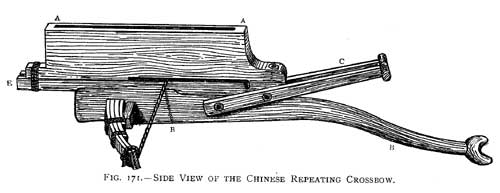
The Panjagan is described as a weapon that could fire 5 arrows at once.
Panj (Middle Persian)=Five.
This was used to devastating effect by the Sasanian Persian army against the Gok Turks in 619 AD.

Thinking how a regular bow could fire 5 arrows at once to any effect is baffling.

However in China a repeating crossbow was invented around the year 200 AD by the chancellor of the Shu Han dynasty, Zhuge Liang. Although similar crossbows are said to have existed before, Zhuge improved the design and fire rate of this weapon.


So what about the Panjagan? Well it might have derived from the weapon Zhuge created.
How did Chinese end up in Persia?

In 263 AD The Shu Han lost to the Wei dynasty and many people of all classes fled the capital city Chengdu and other regions westwards, along the old Silk Route, to Persia.
At that time Persia would have been glad for such reinforcements as it too had a new dynasty, the Sasanian which, by then, had been in power for 39 years with almost continous war with Rome.
If the Persian armies were not fighting Romans they were fighting off the Turks who began raiding the eastern regions of Persia from 483 AD.

This weapon, and no doubt the well drilled Savaran cavalry, kept the Turks out of Iran until the fall of the Sasanian empire in 651 AD.