Sunday, 5 February 2012

Argavan the "Dragon"

The wife of king Artaxias Aruand of Armenia was Satenik, the Alan princess.
As mentioned in my post on him, he fought a war against the Alan tribes that had invaded the eastern regions of Armenia, such as Sakashen.
Moses of Chorene recorded the affair Satenik had with a nobleman known only as Argavan who he said was a Dragon.
It seems that Argavan bears an Iranian name.

Amoung the ancient Steppe Iranians, such as the Alans, it was normal for the standard of the cavalry to be in the shape of a beast.This would be made from bronze and the mouth would be hollow. To the back of the head was attached a long fabric, made of cotton or even silk and sock-like.
Dacian cavalry standard from Trajan's Column

During the cavalry charge, the rush of wind would play on the cuttings of the bronze teeth, and the force of wind coming out the end of the sock made a "howling noise". If dozens of standard bearers were in action like this, the effect on those attacked would be unsettling to say the least.
Sarmatian cavalryman, a relief found on the north wall of Chester Roman fort, England.
The Sarmatians were akin to the Alan people and may have been one and the same. Such peoples were a state, ruled by an upper class. It was they that gave the name to a nation, and foreign writers such as the Greeks and Romans, would refer to the entire people under the rule of this class as one and the same as them. The Parthians are now thought to have been a heterogenous grouping of tribes, even including Mongolian types in that far back era.
The Roman historian Ammianus Marcellinus, writing around 378 AD, stated that the Alan men were "...tall and good looking, their hair is generally blond and their eyes are frighteningly fierce."

It seems that the Steppe Iranians had long been associated with this "Dragon" ever since they moved into the Iranian plateu and the Caucasus. King Azhdahak of the Medes, who ruled around 550 BC, was refered to as a "Dragon." And even Satenik's son, Artavasdes, was accursed as being a "Dragon" and taken by "Dragons" upon mount Azat-Massis to live for eternity within it.
Regarding "Dragons" on this mountain, they may symbolise the earth tremors that still rack it, or they may refer to that area being settled by Steppe Iranians, as far back as 550 BC when king Azhdahak's enslaved people were said to have been settled there by the victorious king Tigran in the legend by Moses of Chorene.

Regarding Satenik, Argavan and Artavasdes, it is safe to say that "Dragon" refers to them being Alan or of Alan parentage.

Sunday, 29 January 2012

State of war in words

It is a shame that the publication
" The Armenian People, from Ancient to Modern Times: 
Vol I: The Dynastic Periods: from Antiquity to the Fourteenth Century" by Professor Richard G. Hovanisian has been the victim of a petition by some academics of the Republic of Armenia over supposed wording that could be construed to infer that Armenians are foreign to the region.
I have both volumes 1 & 2 and never found anything to complain off so far.
In a purist historical way, to understand the tribes of the ancient past, to accept that modern nations are built on a rich history and prehistory of differing peoples, is now impossible in the Republic of Armenia and as a subject of discussion in general.
This is because the Republic of Azerbaijan, with its petro dollars, is waging a war of words.
These words involve the concoction of an unbroken history that sees the Sumerians as being the founders of the Azerbaijani nation north of the Araxes river thousands of years ago. This fantasy had been the creation of Pan Turkist "scholars" in the 1970's.
No serious, honest, scholar accepts any of this. 
This war is also being fought online in particularly on YouTube were anyone can make a "documentary" and it is likely national governments follow such "documentaries" if not sponsor them.

The result of this war of words is that merely to write how for example "the Urartuans invaded the Armenian Highland from the south and created a kingdom" or "the Cimmerians, Scythians invaded the Armenian Highland from the north and settled down" or "Phrygian tribes invaded Anatolia and reached as far as the Armenian Highland and settled down".
None of this infers that no one was living in the Armenian Highland before any of these people decided to invade, prior to that the Armenian Highland is mentioned by the Assyrians as the land of "Nairi" and a very prosperous and populated land at that. Civilization reaches back thousands of years in that land, even by there mere artifact of a shoe testifies to specialist skills, and so, civilization.

The problem is, mental health sufferers who can pass of or get dressed up by governments with nationalist agendas as bonafide experts will seize on anything that refers to tribes "invading" the Armenian Highland to mean that all the Armenian people invaded it and are therefor illegal occupants. Pasting onto this nonsense is the Sumerian origin myth.

In the west we are free to look deep into the fault lines of history without fear that by doing so will bring about an invasion by a hostile country.
Alas this is not the case in the Republic of Armenia, where any such inquiries must be prevented, as a matter of national security.

Lets make an example.
Imagine during WWI or WWII in England if some journalist wanted to write that "not every German was a blood thirsty monster", such a thing would be treason at the time, probably punishable by long term imprisonment, and the writer would probably become the victom of a hate campaign.
Theoretically what such an imagined journalist would not be wrong. But to make such statements to the public at a time of war would jeopardise public moral and even the war effort.
Such a statement could be seized by "tosh mongers" of the Tabloids to become a "headline grabber" such as "enemy traitor loves Hitler" or "execute the German lover!"
Rabid Tabloid nonsense in times of peace deserve the ridicule they are askign for and can be dismissed as ultimately harmless. But in times of war such spoutings will be tacitly allowed by the government, and become the offical mind set of the masses on what is right and wrong to say, and that "all Germans are evil and must be killed."

In that analogy we see why such mentionings in books such as "The Armenian People, from Ancient to Modern Times" of the formation of the Armenian people can be seized upon as "treason" and the result is that now no in depth study of Armenian history can ever be done in the current war situation.

So references to Herodotu, who stated that warriors living in western Armenia wore Phrygian hats, Strabo stating that the religious customs of the Armenians came from the Medes, must be banned. 
It never dawns on the modern censor that these real ancient witnesses are proof of the existence of Armenia in ancient times, wheras they do not mention the existence of Azerbaijan.

To theorise that the ancient region of "Sakashen" refers to the Scythians who invaded from the north in the 6th century BC or that the ancient city of Gyumri derives its name from the Cimmerian people who invaded from the north, before the Scythians is now like a blasphemy, deserving a Fatwa. 
That these were singular settlements amongst a larger native population does not factor in.
It does not infer that everyone settled there in an empty land and the people of the Republic of Armenia have no right to live there. 
However as stated, such studies are seized upon by the Pan Turkic government of Azerbaijan and contorted to infer just that, that the Republic of Armenia has no right to exist.

As stated, in the west, such historical observations would attract little interest in the general public and be of no concern to national security. 
This does not work in the troubled Caucasus region of today. 

Friday, 27 January 2012

When is a "Roman" not a "Roman" ?

On seeing a portrait of Emperor Septimius Severus with his wife and two sons, I was struck by what could be called the "Byzantineness" of the style.

This caused me to reflect on the nonsense of the classification of "Byzantine", "Byzantines" and "Byzantine" empire.
Since the 19th century western scholars blithely use the name "Byzantine" in the mindset that the people of the Roman empire, ruled from Constantinople, were not Latin, did not speak Latin and so were no longer Roman. Quite overlooking the fact that in titular addresses the word Roman was used to describe their empire and citizens.

Why the Severan portrait made me realise this nonsense was...
1) Septimius was of Punic (Phoenician) origin.
2) He was born in the town of Leptis in Libya.
3) He spent much of his reign ruling the Roman empire away from the city of Rome.
4) His wife was Aramaic from Syria.

So, Septimius must be a "Byzantine" then, he sounds so "un-Roman" and look at how decadent he dressed.
Well, he ruled from 193 - 211 AD, 119 years before the founding of Constantinople by emperor Constantine in 330 AD, and the supposed creation of the "Byzantine" empire as a result of this.

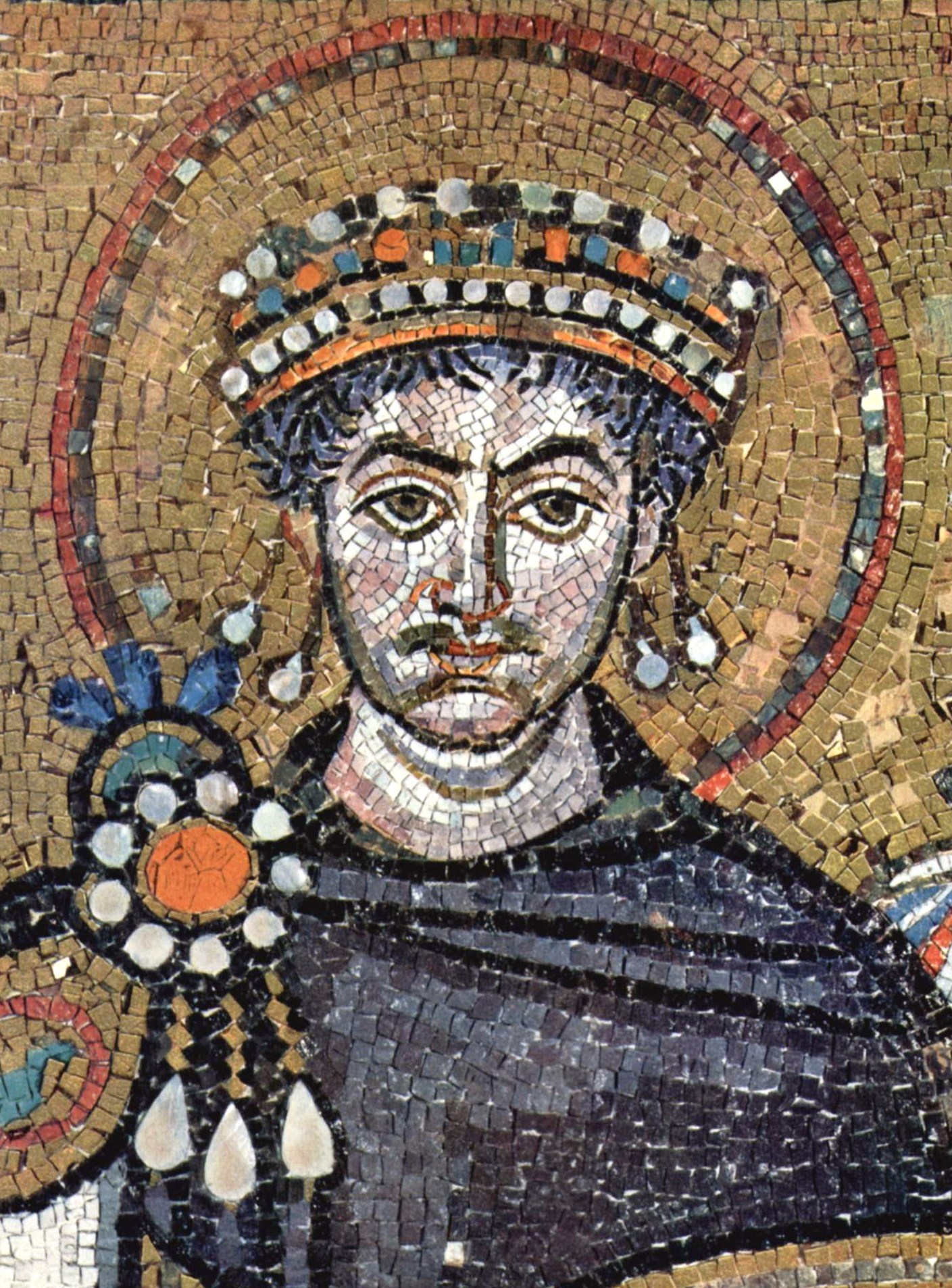
Lets compare with emperor Justinian I, supposed "Byzantine" and ruler of the "Byzantine" empire.
Justinian ruled the Roman empire from Constantinople from 527 - 565 AD.
He referred to himself as Roman, his empire as Roman and his citizens as Romans.
1) Born in Dalmatia of Latin origin.
2) Never ruled from Rome but from Constantinople, even though by 560 AD Rome was again under imperial rule.
3) His wife, Theodora, was Greek.

At the very least it can be argued that Justinian being of Latin origin would be considered more of a Roman than Septimius.

If you rely on the "History Channel" for your historical education, you will be in dire need of educational therapy in the form of researching such things as the "Byzantine" empire for yourself.

In the reign of emperor Heraclius this is also given by scholars as the time the "eastern" empire became "Byzantine" because for purely administrative purposes during a 26 year war against the Persian kingdom he made all state correspondence in Greek. However on coinage Latin was still used.
On the above coin, we read on the obverse side "DN HERACLI-US PP AUG" whilst on the reverse we read "VICTORIA AUGUS". His style is no more decadent than of Septimius.
1) Born in Cappadocia of Armenian origin. During the reign of emperor Maurice family settled in the Exarchate of Africa .
2) First wife, Eudocia, Greek name, possibly also of Armenian origin. Family settled in the Exarchate of Africa. Second wife, Martina, was his niece (!)
3) Though Rome was under imperial rule, Heraclius never went there.
A gold Solidus from the reign of Heraclius, on the obverse he is shown with his son Constantine beside him, circa 620 AD.
A gold Solidus showing emperor Licinius beside his son, Licinius II, circa 320 AD.


These "un-Roman" characteristics seem similar to emperor Septimius.
But wait, by the time of Heraclius, the empire was known as a "Greek" or "Byzantine" empire!
The Muslim Syrian scholar Ismail ibn Kathir, writting around 1350 AD, still referred to the empire as Roman. In a eulogy to Heraclius he wrote: "He ruled the Romans with great leadership and splendor."


In summary, a serious historian needs to read other sources, especially non 19th & 20th century Frankish sources which had their own imperial agenda, to understand when a "Roman is not a Roman".

Tuesday, 24 January 2012

Why mount Masis is not mount Ararat

Doing a course on Armenian history, I took out a fine old Armenian publication «Հայկական Սովետական Հանրագիտարան» (Soviet Armenian Encyclopaedia) 1976 edition.
No interest in any of the Soviet propaganda that may exist in it.
These are famous encyclopaedias in Armenia and the Diaspora, with a wealth of information about Armenian culture and history that until the Internet age, was so hard to find.

There is a double-page map of Arsacid (Arshakuni) Armenia of the 4th century AD.
I was looking at the old province of Gortuk (Gordyene) when my eyes saw in clear Armenian writting «Արարադ Լ.»
That means Mount Ararat.

Looking on Google Map for the present name of this mountain, I learnt it is now called mount Judi.

Apparently, for the early Christian church (and even today in Judaism and Islam) this was the location of the mountain that "Noah's Ark" set upon after the Flood.

The mountain that almost all diasporan Armenians call "mount Ararat" was actually called, according to the map in the encyclopaedia «Ազատ-Մասիս» (Azat - Masis).
Confusingly the map makers have kept the modern provincial name of the area, «ԱՅՐԱՐԱՏ»(Ararat).

Azad-Masis may derive from the Avestan title Yazata-Mazista which equates to "the venerable, the greatest".
This 5,137 meter high extinct volcanic mass was called the "Palace of Aramazd and Astghik"* by the ancient Armenians.
The lower south-eastern slope, which in the Arsacid map is called "Մասիս" (Masis and Diasporan Armenians call this summit, Masis whilst those of the Republic call Sis) was said to be "a place of incessant fire, of Dragons"*.
At the base of this mountain was a sacred spring called "Buth"*.
This probably derives from the Avestan deity of the water, "Burz".

A possible scenario is that the mountain could not be destroyed, like the pagan temples, by the zealous Gregory the Illuminator and his successors in their mission of converting the kingdom to Christianity, and so, the mountain was renamed to something Christian.

But there was already a mountain called Ararat, in the province of Gortuk?
Alas, this province did not remain under Armenian control.
How?
Due to Armenia being brought into an alliance with the Roman Emperor Julian II (who reverted to Paganism) the kingdom was expected to provide military aid for his campaign into Mesopotamia (Iraq) to attack the capital of the Persian kingdom, Ctesiphon.
So?
After initial victories, the Roman army was dicisively defeated at the "Battle of Samara" and Julian was killed.
Okay, what about "the real mount Ararat" and Gortuk?
After the Romans were defeated and left to find a new leader, Jovian, and make large concessions to Persia to survive and escape back to the Roman empire, they made a treaty with the Persian king.
This involved ceding control of most of Armenia to Persia, including the province of Gortuk.

It seems that the real mount Ararat in Gortuk was forgotten, the region that sired the "Urartuan" people.

And that original Ararat was forgotten by western Christianity, but not by the local Armenians, or Judaism or Islam.

So in summary, yes "Noah's Ark landed in Armenia upon mount Ararat", just it was in the Armenian province of Gortuk.

*See "Armenian Mythology" by Mardiros H. Ananikian, from "The Mythology of All Races: Volume VII", (published in New York, 1925)


Sunday, 24 April 2011

The Paulicians: A timeline & map

Ten years ago I read about the Paulician sect, I decided the read about them again and draw a timeline of their "rise and fall" and also to make a map that will help understand where they were based and their activity.
Below is the timeline of events.


  • 555- Council of Dvin, Catholicos Nerses II says Paulicians living on the Armenian borderlands (Byzantium/Persia).
  • 645- Council of Dvin prohibits use of monasteries as hotels for aristocracy, accompaied with singers and dancing girls.
  • 650- Armenia under Muslim control.
  • 655- Council of Dvin mention against Paulicians.
  • 658 Constantine-Silvanus, their second leader, establishes congregation at Kibossa.
  • 660-Anania teaches at Dvin, finds pupils to be lazy, arrogant and passing themselves of as tutors whilst their own studies were unfinished, bringing disrepute to Anania.
  • 668- Emperor Constans II murdered by Count Mzhezh, who proclaims himself Emperor.
  • 670- Paulicians reject Baptism for babies, only allowing adults over the age of 30 to be fully baptised by immersion.
  • 673- Muslims capture Rhodes and Cilicia.
  • 685- Constantine-Silvanus stoned to death, by order of the Byzantine emperor. The Byzantine officer, Simeon, joins the Paulicians and adopts the name of Titus.
  • 688/717- Paulicians mentioned as "Troublemakers" by the Armenian Apostolic Church
  • 690- Simeon-Titus is burned to death by order of the Bishop of Colonia, near Kibossa.
  • 691- Paul, the new leader, makes leadership of Paulicians hereditary. He establishes a new congregation at Eupatoria.
  • 715- Paul dies, his eldest son, Gegnasius, named successor. His younger son Theodore rebels but is unsuccessful. Gegnasius arrested and taken to Constantinople to be interrogated on Heresy but is aquited, establishes new congreation at Mananali as Eupatoria is no longer safe for him.
  • 720- Council of Dvin convened to curb bad behaviour of the clergy.
  • 745- Gegnasius-Timothy dies in Mananali. Two men, Zacharias and Joseph establish their own groups. Joseph adopts name of Epaphroditus, and has the most followers.
  • 747- Gregory Mamikonian rebels against the Muslim Ostikan of al-Arminya with the aid of the Paulicians.
  • 750- Paulicians of Samosata all executed by the Emir for trying to leave the town.
  • 751- Meletia captured by Byzantium, Armenians deported by Emperor Constantine V to Philippopolis, Thrace.
  • 756- Paulicians of Karin deported by Emperor Constantine V to Philippopolis, Thrace.
  • 768- Council of Dvin prohibits marriage of Armenian Apostolic Christians to muslims.
  • 775- Joseph-Epaphroditus dies at Mananali, succeeded by Baanies who adopts the name of Zachary, however division remains. Sergius is leader of the reform group and is an active evangelist. He boasted he had sent missionaries "from East to West, from North to South". The following decades sees the two groups fight, the Baanite group is almost destroyed.
  • 787- The end of the first period of Iconoclasm in Byzantium.
  • 790- Alexius Mushel governor of Armeniakon, supports the Iconoclast Emperor Constantine VI until 791, then becomes Emperor himself until 793.
  • 801- Death of Baanies-Zachary. Sergius is now officially leader of all Paulicians and he adopts the name of Tychicus.
  • 802- Paulician army assists Nicephorus to become emperor.
  • 805- Due to perseuctions of the Empress Irene, Sergius-Tychicus, who would be most active for the next 34 years, leaves Byzantium for the emirate of Meletya with 5,000 followers, is given control of borderlands and founds the towns of Argaum/Arguvan and Amara (Amran Köyü).
  • 835- Death of Sergius-Tychicus, many leaders take control of Paulician sect.
  • 838- The city of Amorium sacked by the Caliph's armies.
  • 843- Empress Theodora starts persecution of Paulicians
  • 855- Huge military expedition against Paulicians, around 100,000 killed. Some escape to the emirate of Meletia. Emir Umar al-Adta allows Karbeus to establish new base for Paulicians at fort of Tephrike. The old Armenian marriage practise of Consanguinity continues in the Paulician elect, next Paulician leader Chrysocher is both nephew and son-in-law of Karbeus.
  • 859- Emperor Michael III invades the Djazirya region.
  • 863- Joint Muslim and Paulician invasion of Anatolia, sacks town of Amisos, but wiped out at the battle of Lalakaon in Paphalgonia, possibly near Kastamonu. Emir and Karbeus both die.
  • 863- November. Ali ibn-Yahya 'the Armenian' and Ostikan of al-Arminya and Azerbaijan, killed by emperor Michael III at Mayafaraqin.
  • 867- Chyrsocher, leader of Paulician-Muslim army invades Anatolia, sacks Ephesos then moves north and attacks city of Nicea. Many Clergy taken captive.
  • 868- Emperor Basil I sends Petrus Siculus to Tephrike to arrange exchange of hostages, while he is there he writes his "History of the empty and vain heresy of the Manichæans, otherwise called Paulicians". Peace talks fail.
  • 872- Emperor Basil I captures and destroys the city of Tephrhike, the Paulician leader Chrysocher is also executed, his head taken back in triumph to Constantinople. Survivors flee to the remote regions of Armenia, mostly in Taron and gain support of the Bagratuni prince, who is supposed to have written 'The Key of Truth' in homage to them.
  • 882-Samosata falls to the Roman (Byzantine) army.
  • 971- Many remaining Paulicians in Anatolia are rounded up by order of Emperor John I and deported to Philippopolis, Thrace and the re-established eastern-Danube frontier zone. They prolythetise to the Bulgars and assist their Tsar, Boris, who adopts their teaching.
  • 1096- The first crusade passes through Philippopolis and meet the Paulicians.
  • 1097- The 'Gesta Francorum' records Paulicians serving in the Turkish armies that fought the Crusaders near the city of Dorylaeum.
  • 1118- Anna Commnena who wrote in 1118AD, said Philippopolis was 'a meeting place, so to speak, of all polluted waters'.
  • Resurfaces at the town of T'ondrak, from which the sect is known afterwards as the "Tondrakians", sect continues until 1800's.

Sunday, 10 April 2011

The "Drafsh" Emblem.

When I was in Armenia, I went to see the 4th century AD Basilica Church of "Surp Nshan" (Holy Seal) near Abaran.
Photo taken in November 2010, at the Surp Nshan Basilica, Republic of Armenia.
Outside in the courtyard are some ruins, one of which caught my eye. It had a Cross inside a circle, and itself looked like a banner used in battle as it was upon a pole. At either side was a person, eroded away, yet still visible.


This looked like a battle standard, most likely used either by the Arshakuni kings of the 4th century or the Bdeshk families such as the Kamsarakan or Mamikonian.


Back in London I began to read about the Achaemenid empire, and came across a rendition of a motif from the tunic worn by King Darius I at Persepolis.
I also saw two coins minted by the Satrapy of Caria around 395 BC and 344 BC, and drew the motifs on their Reverse sides..
I then learned about the "Pazyryk" carpet from a tomb in the Altai mountains, that is dated to around 400 BC, originating from Achaemenid Iran. It bears many examples of the "Drafsh" motif.
I also began to read about the Sassanian era, and the "Drafsh" of Kaveh, perfectly depicted on the reverse of this coin from around 100 BC of the ruler of Persis, Artaxerxes.
 
Obverse: Artaxerxes, king of Persis. Reverse: Artaxerxes offering prayers to a temple, the Drafsh of Kaveh is at the right hand side.
The Star motif was also used by the dynasty that ruled Pontus from 302 - 37 BC, among whom were king Mithridates VI. His ally and son-in-law was king Tigran II of Armenia, and below is my illustration of the motif used on his crown.


A Tetradrachm of king Tigran II. His crown bears the star motif.


 Reading Dr. Kaveh Farrokh's book "Shadows In The Desert" I saw a photo of what is called the "Cup of Khosrow" and I noticed the "Drafsh" motifs which decorated it.

I drew an example of one of them.
 On further reading of "Shadows In The Desert" I saw a photo of a fresco from the palace of an Ummayad Caliph, near ancient Palmyra. Called the "Qasr Al-Heir El Gharbi" the paintings have a border of "Drafsh" running around them.

Below is my drawing of one of them.
On further reading I learnt that the "winged emblem of Zoroaster" had been in use before by the Assyrians.
Below is my drawing of a star motif on a stele from the reign of king Ashurbanipal II, circa 850 BC.


This Star motif went back further, I saw a photo of a boundary stone from the reign of king Meli-Shipak II of Babylon, circa 1186 BC which had the star on it.

My drawing of the star upon the boundary stone.


What can be surmised is that this star motif had a deep meaning in the successive dynasties of Mesopotamia, what it's exact representation is though, is another question.

The Fire Temples from the Sassanian Occupation of Egypt and Cappadocia

I couple of years ago I chanced to come across an image of what is described as a "mosque" in the city of Kayseri, Turkey.
Kayseri was originally called Caesarea, it was the capital of region of Cappadocia and by the 4th century AD it was the main centre of Christianity in all of Anatolia.

In 615 AD General Shahin invaded Anatolia for the Shah of Persia, Khosrow II.

This "mosque" look nothing like a conventional mosque, it has no mineret, the area for prayer is not at ground level but on the 1st floor. The structure is cube shaped and has 4 doorways, 1 on each side.
General Shahrbaraz invaded Egypt in 616 AD for the Shah of Persia, Khosrow II.

In 868 AD General Ahmad Ibn Tulun invaded Egypt for the Abbassid Caliph of Islam. He soon made himself independent of the Caliph, and created a city called Al-Qatta'i.
He also had a mosque built, in the centre of which is called an "ablution fountain". The structure is cube shaped and has 4 doorways, 1 on each side.

Compare with my drawing of the Fire Temple at Firuzabad in Fars province, Iran, that dates back to around 224 AD.
It is my belief that when Cappadocia and Egypt came under Persian control in 615 AD and 616 AD respectively, Fire Temples, along with a religious complex or military barracks were built either in their capitals, such as Caesarea or near the military base of "Fort Babylon" in Egypt, which later became Fustat.

When Cappadocia, and its city Caesarea, were recaptured in 624 AD by Emperor Heraclius and the reoccupation of Egypt by 628 AD these Persian structures would have been pulled down. The ruins of which could have been rebuilt later on by new conquerors, such as the Seljuk Turks in Anatolia and the Turkish dynasty of Ahmad Ibn Tulun. Persian culture was very influencial on successive Turkish dynasties, did they knowingly seek out these ruins from Persia's glorious past or was it mere coincedence?